The Sustainability Myth: Is Digital Really Greener Than Print?
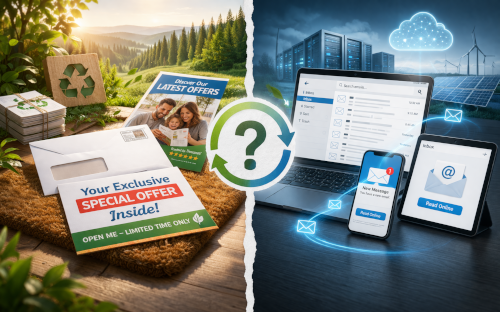
Going paperless is often seen as the greener choice. But is it really that simple?
For many organisations, moving communication online is assumed to reduce environmental impact. However, sustainability is more complex than a simple switch from print to digital.
According to Two Sides, the global initiative promoting the responsible production and use of print and paper, paper is one of the most recycled materials in Europe and is produced using renewable raw materials sourced from responsibly managed forests.
This challenges a widely held perception. Print is often viewed as environmentally harmful, yet the industry operates within a renewable and highly recyclable system.
Key Sustainability Facts About Print
Several important facts about paper production and recycling are often overlooked. Paper is made from renewable raw materials sourced from responsibly managed forests where trees are continually replanted.
It is also one of the most recycled materials in Europe, with well established systems that allow fibres to be reused multiple times before reaching the end of their lifecycle. This supports a circular approach where materials stay in use for longer rather than becoming waste.
Paper Comes from Responsibly Managed Forests
A common misconception is that paper production leads directly to deforestation. In reality, most paper used in Europe comes from responsibly managed forests where harvesting is carefully controlled and trees are replanted to maintain healthy ecosystems.
According to Two Sides, forest areas across Europe have increased over recent decades due to responsible forestry management and replanting programmes. When sourced correctly, paper remains a renewable resource.
Paper Recycling Systems Are Well Established
Paper benefits from strong recycling infrastructure across Europe. Fibres can be reused several times, helping to reduce waste and extend the value of raw materials.
Because of this, paper and cardboard are widely recognised as sustainable materials for both packaging and communication.
Regulation Is Encouraging Further Progress
Environmental regulation is also supporting continued improvements within the print and paper industry. The EU Packaging and Packaging Waste Regulation aims to increase recycling targets for packaging materials by 2030.
Paper and cardboard are already well positioned to support these targets due to their high recyclability and established recovery systems. This is driving further investment and innovation across the sector.
The Environmental Picture Is More Complex Than It Seems
Digital communication is often viewed as environmentally neutral, but it relies on extensive infrastructure.
Emails, online advertising and digital storage all depend on data centres, networks and devices that require continuous energy to operate. While print relies on renewable materials and recycling systems, digital channels depend on energy intensive technology.
To understand the true environmental impact, businesses need to consider the full lifecycle of both print and digital rather than assuming one is automatically more sustainable.
Why Print Still Matters in Customer Communication
Alongside sustainability, print continues to deliver strong results for marketing and customer communication.
Printed materials attract attention in ways that digital messages often struggle to achieve and can remain visible in homes and workplaces for longer. Direct mail and door drops also offer a tangible experience that digital channels cannot replicate.
When combined with accurate targeting, print can reduce wasted impressions and improve campaign effectiveness, helping businesses achieve better return on investment.
Supporting Targeted Print Campaigns
At CX Services, we support businesses across the UK with targeted print and direct mail campaigns designed to reach the right audience.
Our services include data management, personalised digital printing, mail fulfilment and distribution. By combining precise targeting with efficient production, businesses can deliver relevant communications while minimising unnecessary waste and improving campaign performance.
Making Informed Communication Decisions
The conversation around print and sustainability continues to evolve. Research from organisations such as Two Sides highlights the progress being made across the print and paper industry, from sustainable forestry to well established recycling systems.
Understanding this broader picture helps organisations make more informed decisions about how they communicate with their customers while balancing environmental considerations with marketing effectiveness.
If you would like to learn more about the sustainability of print, you can read the full Print Positives for 2026 article from Two Sides here:
https://twosides.info/UK/print-positives-for-2026/
If you are considering how print or direct mail could support your next campaign, our team at CX Services can help you plan and deliver an effective communication strategy.